Thermal management strictly limits product lifespan and reliability in modern electronics. If internal components run too hot, they eventually fail prematurely. An extruded Aluminum Heat Sink is only as effective as the specific alloy grade and temper you choose during the design phase. Engineers constantly face a fundamental tension in manufacturing. You must balance raw thermal conductivity against practical extrusion feasibility. Highly conductive metals often resist being pushed through complex dies to form dense, thin fins. This guide provides a straightforward, evidence-based evaluation of viable extrusion alloys. Engineering and procurement teams can use this breakdown to confidently finalize material specifications. We will explore how different alloys impact thermal performance, structural integrity, and manufacturability, ensuring your next thermal management project succeeds.
Key Takeaways
- 6063 is the industry standard: Offering ~200 W/m·K thermal conductivity, 6063-T5 provides the optimal balance of heat transfer and high extrudability for complex fin profiles.
- 6061 is for structural priorities: While it sacrifices roughly 15-20% in thermal conductivity compared to 6063, 6061-T6 is necessary when the heat sink must bear significant mechanical loads or undergo extensive secondary machining.
- 6060 excels in extreme extrusion: For ultra-thin fins and high aspect ratios, 6060 allows for intricate geometries that other alloys would break or warp during extrusion.
- Temper matters as much as the alloy: The choice between T5 and T6 tempering significantly alters both the thermal properties and the structural rigidity of the final component.
Why Alloy Choice Dictates Extruded Aluminum Heat Sink Viability
The Feature-to-Outcome Link
Alloy composition directly influences thermal resistance. The 6000-series aluminum alloys primarily rely on magnesium and silicon as alloying elements. Magnesium increases the structural strength of the metal. Silicon lowers the melting point and significantly improves extrudability. However, there is a catch. When these elements remain dissolved in the aluminum matrix, they scatter heat-carrying electrons and phonons. This scattering drops the overall thermal conductivity. You must carefully control the ratio of magnesium to silicon. Proper heat treatment forces these elements to form magnesium silicide precipitates. This process restores thermal conductivity while maintaining adequate strength for the final component.
The Manufacturability Bottleneck
Extrudability heavily impacts your bottom line. "Extrudability" refers to how easily the heated metal flows through a steel die. Alloys with lower extrudability create immense friction. They force manufacturers to design wider fin spacing. They also require thicker fin bases. Consequently, you achieve lower aspect ratios. This limitation ultimately reduces the total surface area available for cooling. If you cannot extrude enough fins into the profile, you lose convection cooling power. The raw thermal conductivity of the metal cannot easily compensate for a severe lack of surface area.
Tooling and Yield Implications
Harder alloys cause faster die wear. When you push tough alloys like 6061 through intricate tooling, the die tongues experience massive stress. This stress leads to rapid tooling degradation. Manufacturers must run the extrusion presses at much slower speeds to prevent die failure. Slower speeds mean lower production yields. Lower yields inevitably drive up the per-unit cost at scale. By choosing a highly extrudable alloy, you extend tool life and speed up production rates. This keeps manufacturing highly economical.
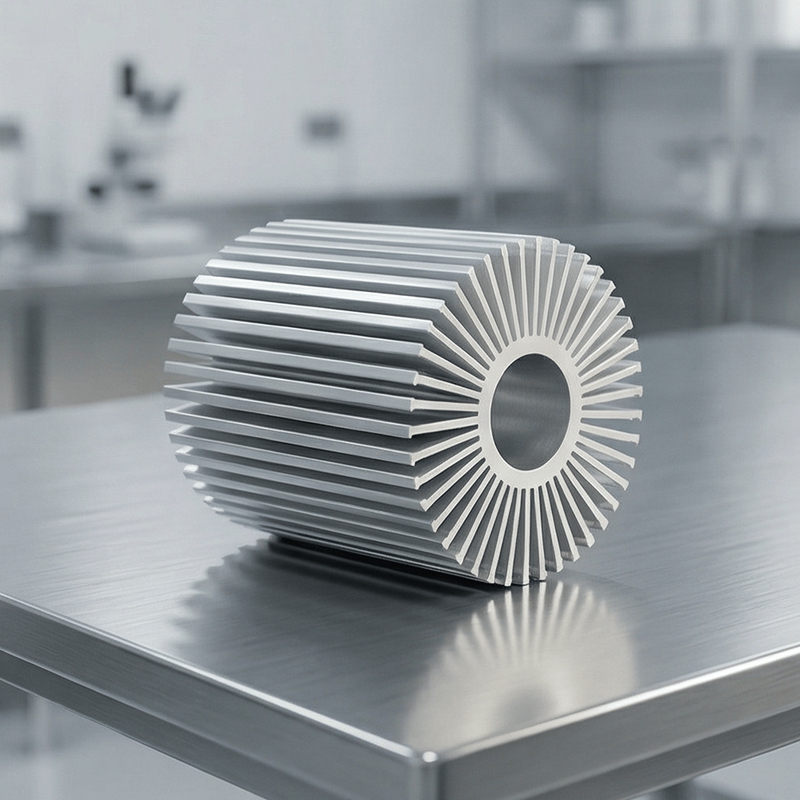
The Core Contenders: Evaluating 6063 vs. 6061 vs. 6060
Selecting the right material requires understanding the nuances of the 6000-series family. Below is a comparative overview of the top three choices.
| Alloy Grade | Thermal Conductivity (W/m·K) | Extrudability Rating | Tensile Strength (MPa) | Primary Use Case |
| 6063-T5 | ~201 | Excellent | ~186 | Standard commercial cooling, LEDs |
| 6061-T6 | ~167 | Poor to Fair | ~310 | Structural chassis, heavy machinery |
| 6060-T5 | ~209 | Outstanding | ~150 | Micro-channels, extreme fin density |
Alloy 6063 (The Baseline Choice)
Alloy 6063 stands as the undisputed industry standard. It boasts a thermal conductivity of approximately 201 W/m·K. It delivers an excellent surface finish capability straight from the press. We see it used constantly for standard commercial cooling, LED housings, and consumer electronics. The material flows beautifully through complex dies. However, it presents some trade-offs. It features lower tensile strength compared to structural grades. You should not use 6063 for heavy structural load-bearing applications. It is strictly optimized for moving heat.
Alloy 6061 (The Structural/Machining Choice)
Alloy 6061 prioritizes strength over thermal efficiency. It offers roughly 167 W/m·K of thermal conductivity. It provides incredibly high tensile strength and excellent machinability. It is best for aerospace, military, or heavy industrial equipment. In these sectors, the Aluminum Heat Sink often serves a dual purpose as a structural chassis. It must survive intense vibration and mechanical shock. The trade-offs are significant. You face a noticeably lower thermal conductivity. It is also remarkably harder to extrude into high-density fin profiles. You will likely pay more for tooling and production.
Alloy 6060 (The High-Density Choice)
Alloy 6060 pushes extrusion limits to the maximum. It yields excellent thermal properties, typically between 200 and 209 W/m·K. It offers maximum extrudability among the common grades. It is absolutely best for micro-channel configurations. You need 6060 for ultra-thin fin requirements and tight-space electronics. It handles intricate geometries flawlessly. The main trade-off is its very low mechanical strength. It is highly susceptible to fin bending during transport. Rough handling on the assembly line can easily deform the delicate cooling fins.
Key Evaluation Dimensions for Material Shortlisting
Thermal Conductivity vs. Surface Area
You must constantly weigh the mathematical trade-off between conductivity and surface area. An alloy with lower thermal conductivity might seem acceptable on paper. However, it will fail your thermal tests if its poor extrudability limits the fin count. Convection cooling relies heavily on exposed surface area. If you use 6061, you must use thicker fins. Thicker fins mean fewer fins fit onto the base. You lose total cooling area. A highly conductive 6063 profile with 30 thin fins usually outperforms a strong 6061 profile with only 15 thick fins. Always prioritize surface area for passive cooling applications.
Temper Designations (T5 vs. T6)
The temper designation changes the material fundamentally. You cannot specify an alloy without specifying its temper.
- T5 Temper: The metal cools from an elevated temperature shaping process. Workers then artificially age it in an oven. This process is usually sufficient for 6063 heat sinks. It relieves internal stress and offers better thermal metrics. It keeps manufacturing fast and affordable.
- T6 Temper: The metal undergoes solution heat treatment. Workers quench it rapidly and then artificially age it. This temper is absolutely necessary for maximum strength. However, the rapid quenching introduces residual stress. It also slightly impairs the overall thermal efficiency of the material.
Fin Aspect Ratios
The aspect ratio measures the fin height against the fin thickness. It defines your cooling geometry. Standard industry baselines dictate your design boundaries. For example, 6063 can comfortably achieve 10:1 or 15:1 aspect ratios. You can design tall, elegant fins without breaking the die. In contrast, 6061 struggles immensely with tall features. Pushing 6061 past an 8:1 ratio drastically increases die failure risks. The tough metal drags on the tooling. This drag tears the steel or bends the profile. Staying within safe aspect ratios keeps your project on budget.
Implementation Risks and Secondary Operations
Anodizing and Surface Finishing
Different alloys react distinctly to electrochemical anodizing. Anodizing provides corrosion resistance and improves thermal radiation. Alloy 6063 provides a superior, uniform cosmetic finish. It accepts black anodizing perfectly. Black anodizing significantly improves radiant heat transfer. This makes it ideal for fanless, passive cooling systems. Alloy 6061 contains more silicon and copper. These additions can make the anodized layer look dull, gray, or blotchy. If cosmetic appearance matters to your consumer product, 6063 is the much safer bet.
Post-Extrusion CNC Machining
Most thermal profiles require secondary operations. You need to add mounting holes, flatten the base, or cut cross-cuts for omnidirectional airflow. Alloy 6061 shows clear superiority here. It produces small, easily cleared chips during CNC milling. It machines quickly and cleanly. Alloys 6063 and 6060 can behave quite differently. They are softer and feel "gummy" to the cutting tools. The metal tends to stick to the endmill. Machinists must use slower feed rates and specialized tool coatings to prevent smearing. This extra care adds machining time to the final part cost.
Tolerance and Bowing Risks
Extruded shapes often warp. You face the risk of base flatness distortion during cooling. Secondary machining releases internal stresses, which also causes bowing. Base flatness remains a highly critical factor. The sink must maintain perfect contact with thermal interface materials (TIM) and the hot processor. A bowed base creates microscopic air gaps. Air acts as a powerful insulator. T6 tempered alloys carry higher residual stress from quenching. When you machine away the skin of a T6 profile, it can warp dramatically like a potato chip. Always specify flatness tolerances clearly on your engineering drawings to avoid thermal bottlenecks.
Decision Framework: Specifying Your Aluminum Heat Sink
Scenario A: Max Cooling, Standard Structure
Default to 6063-T5. This scenario covers roughly 80% of typical electronics. Your device sits on a desk or mounts to a wall. It needs excellent thermal dissipation without supporting heavy loads. This alloy yields the absolute best combination of material cost, thermal performance, and fin density. It simplifies manufacturing and provides excellent cosmetic finishes.
Scenario B: Heavy Load, Complex Machining
Specify 6061-T6. Use this when designing a ruggedized chassis for military radios or industrial motor drives. The part acts as the primary structural housing. You must accept the thermal penalty. You can compensate for the lower conductivity with forced air (active cooling) from fans. You rely entirely on its structural integrity to protect internal boards from physical damage.
Scenario C: Extreme Fin Density, Low Weight
Opt for 6060-T5. This fits compact telecom transceivers or dense LED arrays. You need passive cooling in extremely tight spaces. Fin geometry acts as the sole driver of performance. The ultra-thin fins maximize surface area in tiny volumes. Keep in mind that assembly workers must handle these delicate parts carefully to avoid crushing the fins.
Next-Step Action
You must evaluate your actual heat load before locking in a material. We recommend auditing the thermal design power (TDP) of your components against the required envelope size. Run a preliminary thermal simulation. Then, submit your CAD files to an experienced extrusion partner. Ask them for a Design for Manufacturability (DFM) review. A DFM review catches aspect ratio violations and prevents costly tooling mistakes early in the design cycle.
Conclusion
- Specifying an extruded component requires looking far past raw thermal conductivity numbers on a basic spec sheet.
- The "best" alloy is simply the one that supports your necessary fin geometry while surviving the manufacturing process cost-effectively.
- Alloy 6063 balances conductivity and extrudability. Alloy 6061 prioritizes high strength. Alloy 6060 pushes the limits of fin density.
- Temper selection (T5 vs. T6) plays a massive role in managing residual stresses and final flatness.
- Take Action: Consult with an extrusion specialist today. Evaluate your specific thermal and structural requirements thoroughly. Ensure the chosen alloy matches your production budget and rigorous performance criteria.
FAQ
Q: Can 7000-series aluminum be used for extruded heat sinks?
A: Extremely rare. While strong, 7000-series alloys possess poor thermal conductivity and are notoriously difficult to extrude into finned profiles, making them cost-prohibitive for thermal management.
Q: Does anodizing an aluminum heat sink improve its performance?
A: Yes, specifically black anodizing. While it adds a microscopic insulative layer, it significantly increases the surface emissivity, boosting radiant heat dissipation in passive cooling setups.
Q: What is the standard base flatness tolerance for an extruded 6063 heat sink?
A: Industry standards typically hold flatness to 0.004 inches per inch, though precision secondary CNC machining is often required to achieve tighter tolerances for high-power electronics.