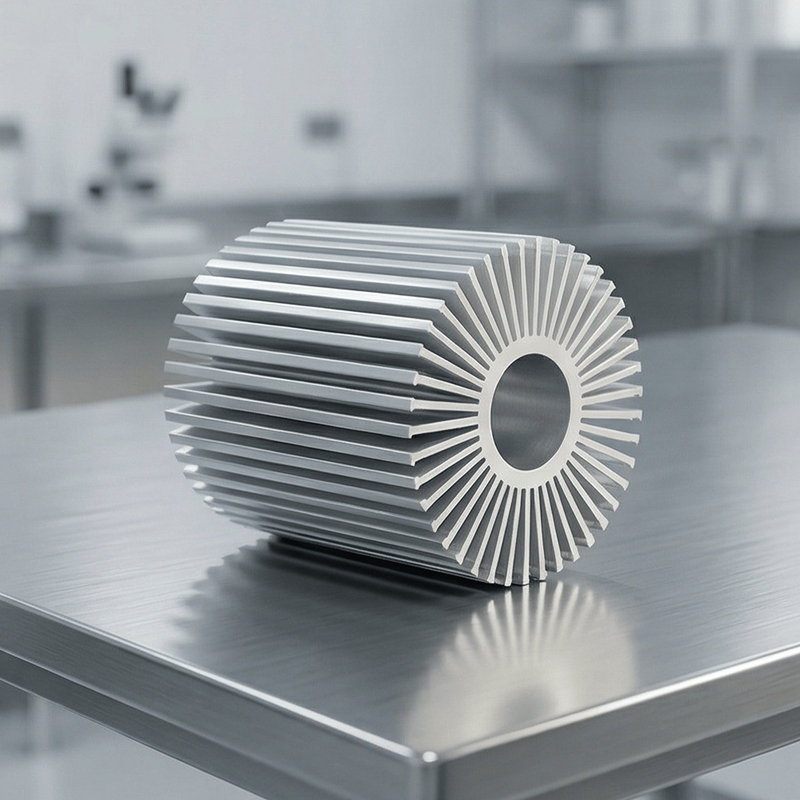
Hardware engineers and procurement teams face extremely high stakes when selecting thermal management components. Specifying the wrong materials inevitably leads to aggressive thermal throttling, massively inflated shipping costs, or frustrating manufacturing delays. The Aluminum Heat Sink serves as the reliable baseline for modern thermal management. It provides a highly necessary balance of thermal conductivity, precise extrudability, and robust structural integrity. Without this precise balance, sophisticated electronic components degrade rapidly under heavy computational loads. You need a systematic approach to bridge the gap between initial thermal modeling and scalable production realities. This comprehensive guide outlines the objective criteria required to evaluate your next cooling project. We explore how to select the exact alloy grade, manufacturing method, and surface finish required to scale production efficiently. By mastering these specific parameters, you guarantee optimal thermal performance while keeping complex production timelines firmly on track.
Key Takeaways
Aluminum 6063 is the industry standard for extrusion due to its optimal balance of thermal conductivity (~200 W/m·K) and complex profile manufacturability.
While copper offers higher thermal conductivity, aluminum dominates at scale due to its 70% lighter weight and significantly lower raw material cost.
Surface treatments like black anodizing do not just prevent corrosion; they measurably increase thermal emissivity in natural convection environments.
Tooling lead times and fin aspect ratio limits (extrusion vs. skiving) dictate which aluminum heat sink manufacturing process is viable for your production timeline.
The Business Case: Why Specify an Aluminum Heat Sink Over Copper?
Copper boasts incredible thermal transfer properties. Yet, seasoned hardware engineers rarely choose it for mass production. You must evaluate the underlying business logic before finalizing a design. Let us explore the precise reasons behind choosing an Aluminum Heat Sink instead of a heavier alternative.
Weight-to-Performance Ratio: You must analyze the specific gravity comparison. Aluminum sits at roughly 2.7 g/cm³. Copper weighs in at a massive 8.9 g/cm³. This fundamental physical reality means aluminum is nearly 70% lighter. Heavy copper components place extreme mechanical stress on printed circuit boards (PCBs). During standard drop-testing, a heavy copper cooler can sheer off its mounting hardware entirely. Lighter parts reduce PCB stress and drastically lower outbound freight costs.
Cost Predictability: Commodity markets severely impact production budgets. Raw copper pricing fluctuates wildly based on global supply constraints. Aluminum provides a far more stable and predictable unit price. This stability protects profit margins across high-volume consumer and industrial electronics production. You can forecast your annual manufacturing budgets with much greater certainty.
Machinability and Tooling Wear: Secondary operations often dictate final unit pricing. Aluminum extends tool life significantly during CNC machining and extrusion processes. Copper behaves in a notoriously "gummy" manner. It sticks to end mills and wears down cutting tools rapidly. By defaulting to aluminum, factories drive down secondary operation expenses and shorten factory cycle times.
How do you establish clear success criteria? You should default to aluminum for standard airflow scenarios, weight-sensitive applications, and high-volume rollouts. Reserve heavy hybrid or pure copper solutions strictly for absolute necessity. Extreme high-heat flux scenarios require copper. Space-constrained data center processors might also demand it. Otherwise, aluminum clearly wins the practical business case.
Evaluating Aluminum Heat Sink Grades: 6000 Series Decoded
You cannot simply write "aluminum" on an engineering drawing. You must specify the exact metallurgical grade to ensure optimal performance. The 6000 series dominates the thermal management industry, but differences exist within the family.
Alloy 6063 (The Extrusion Standard)
Alloy 6063 stands as the undisputed extrusion standard worldwide. It delivers an impressive thermal conductivity of roughly 201 W/m·K. More importantly, it offers unmatched physical extrudability. This unique characteristic allows factories to form highly complex fin shapes. You can easily achieve high fin-density aspect ratios without the hot metal fracturing during production. If you plan to extrude your cooling solution, you will almost certainly specify 6063.
Alloy 6061 (The Structural Alternative)
Sometimes, rigid structural integrity overrides pure cooling capacity. Alloy 6061 steps in as the primary structural alternative. Its thermal conductivity drops noticeably to about 167 W/m·K. However, it boasts a much higher tensile strength than 6063. We specify 6061 only when the component must explicitly bear mechanical structural loads. Ruggedized telecom gear, vehicle control units, and aerospace chassis applications frequently require this rugged grade.
Alloy 1050 (High Purity)
When raw cooling power completely trumps mechanical strength, Alloy 1050 enters the conversation. This high-purity aluminum offers superior thermal conductivity hovering near 220 W/m·K. Because it is physically very soft, you cannot extrude it into intricate shapes safely. Its use case remains strictly limited mostly to stamped components or cold-forged pins where complex extrusion isn't required.
Review the decision matrix below to lock in the correct grade rapidly. It aligns thermal needs against viable manufacturing methods.
Alloy Grade
Thermal Conductivity (W/m·K)
Mechanical Strength
Ideal Manufacturing Method
Primary Use Case
6063
~201
Moderate
Extrusion
Standard electronics cooling, complex profiles
6061
~167
High
Machining, Structural Extrusion
Ruggedized enclosures, aerospace chassis
1050
~220
Low (Soft)
Stamping, Cold Forging
Pin-fin setups, simple high-performance cooling
Manufacturing Constraints: Aligning Design with Production Reality
Beautiful CAD models fail miserably if factories cannot actually build them. Aligning your engineering design with production realities prevents costly redesigns. Let us explore how process selection directly impacts performance and scalability.
Extrusion Limitations
Pushing hot metal through a steel die involves strict physical boundaries. Designers must continuously monitor their maximum fin height-to-gap aspect ratios. Typical limits for standard aluminum extrusion sit around 10:1 or 20:1. If your design features fins that are too tall and tightly packed, the extrusion die will quickly snap under immense pressure. Exceeding these standard ratios requires pivoting to substantially more expensive manufacturing processes.
Skived Fin Solutions
Skived fin technology elegantly solves the high-density cooling problem. Instead of pushing metal through a die, special machines physically slice aluminum directly from a solid metal block. They forcefully fold the sliced metal upward to form incredibly thin fins. This innovative method completely eliminates interface thermal resistance between the base and the fins. It proves ideal for high-density, forced-convection cooling scenarios where space remains tight.
Die-Casting Risks
Do not let cheap unit costs fool your procurement team. Die-casting presents severe thermal performance risks. Cast aluminum suffers a massive thermal performance drop compared to extruded metal. This drop happens due to internal air porosity and the heavy addition of silicon into the liquid alloy mixture. You should find die-casting acceptable only when complex 3D shapes heavily outweigh raw thermal efficiency requirements.
Scalability Check
You must connect your manufacturing choice directly to project timelines. Conduct a rigorous scalability check before finalizing CAD files:
Evaluate Tooling Budgets: Standard extrusion dies are remarkably cheap to produce. Die-cast molds require massive upfront capital expenditures.
Assess Lead Times: Factories can cut an extrusion die in a few weeks. Complex cast tooling often takes months to complete.
Review Unit Volumes: Skiving requires minimal tooling but carries a higher per-unit machining time. Extrusion offers the best balance for scaling into the millions.
Surface Finishes & Compliance: Beyond Aesthetics
Bare metal rarely survives long in harsh industrial or consumer environments. Surface treatments do much more than simply make parts look attractive. They actively dictate thermal performance, electrical grounding, and legal regulatory compliance.
Anodizing (Clear vs. Color)
You must understand the physics of anodizing. This electrochemical process intentionally grows an oxide layer directly on the metal. It dramatically increases the surface emissivity from roughly 0.05 up to 0.80 or higher. We emphasize its absolute necessity in natural convection applications. Passive cooling relies heavily on radiative heat transfer to dissipate energy into the surrounding air. Black anodizing unlocks this radiative potential perfectly.
Chromate Conversion / Chem Film
Sometimes, anodizing creates severe electrical problems. The thick anodized layer acts as a powerful electrical insulator. If your design requires grounding a PCB directly to the metal chassis, anodizing will completely block the electrical current. You must specify a chromate conversion coating or chem film instead. These specific finishes provide solid environmental corrosion resistance while successfully maintaining vital electrical conductivity.
Regulatory Compliance (RoHS/REACH)
Regulatory compliance remains strictly non-negotiable for global brands. Environmental directives heavily scrutinize chemical surface treatments. Procurement teams must mandate that suppliers verify all surface treatments are completely free of hexavalent chromium. Failing a RoHS or REACH compliance check will completely halt your global electronics distribution. Customs agents routinely impound non-compliant shipments. Always mandate modern, trivalent chromium processes to ensure legal distribution across global markets.
Implementation Risks & Quality Assurance Next Steps
Even perfectly designed cooling components fail due to poor execution on the factory floor. Experienced engineers proactively mitigate adoption risks during the pilot phase. Do not skip crucial quality assurance validations.
Base Flatness Tolerances
Pay extremely close attention to base flatness tolerances. A poorly machined base causes microscopic air gaps between the cooling surface and the processor die. To fix this poor contact, assembly technicians instinctively use thicker layers of Thermal Interface Material (TIM). Unfortunately, thicker TIM acts as a thermal insulator. This ruins overall thermal efficiency. You must specify extremely tight flatness tolerances on your drawings. A widely accepted baseline requirement is 0.001 inches per inch. Precision CNC fly-cutting easily achieves this critical metric.
Prototyping Pitfalls
Beware of incredibly common prototyping pitfalls. Engineers often validate a CNC-machined billet prototype early in the design project. They then switch the final high-volume production run to die-casting to save money. This represents a fatal engineering mistake. The thermal properties shift drastically between billet material and cast material. The cast production units will inevitably fail the thermal parameters previously established by the machined prototype.
Vendor Shortlisting Next Steps
We highly advise engineers to demand hard data during vendor shortlisting. Do not simply trust a supplier's marketing claims. You should aggressively request formal material test reports (MTRs) for every production batch. Furthermore, demand rigorous first article inspection (FAI) reports before assembly begins. Scrutinize these reports specifically for fin thickness consistency, gap width, and base flatness. Verify these precise dimensions before committing a single dollar to full-volume production runs.
Conclusion
Successful thermal management depends entirely on a highly rigorous evaluation flow. You must first match the specific heat load to the correct material grade. For most modern electronics applications, Alloy 6063 provides the ideal balance of performance and extrudability. Next, select a scalable manufacturing process that aligns with your tooling budget and required fin geometry. Finally, specify an emissivity-boosting surface finish such as black anodizing to maximize passive radiation. Do not leave these critical physical variables to chance or guesswork. Begin your next thermal project by gathering your exact wattage limits and environmental airflow metrics. Submit your CAD files or thermal parameters to a qualified manufacturing partner today. Request a comprehensive manufacturability review and a custom extrusion quote to ensure your electronics scale flawlessly.
FAQ
Q: What grade of aluminum is best for electronics heat sinks?
A: Aluminum 6063 is widely considered the best overall grade for extruded profiles. It offers an optimal mix of thermal conductivity and high formability. Manufacturers easily push it through complex extrusion dies without fracturing the delicate cooling fins.
Q: How does anodizing an aluminum heat sink impact thermal performance?
A: Anodizing yields minimal impact on direct conduction or forced convection. However, it provides a massive improvement in radiative heat transfer. This finish drastically increases surface emissivity, making it absolutely critical for passive cooling applications.
Q: Why not use 100% pure aluminum for maximum heat dissipation?
A: Pure aluminum, like the 1xxx series, is physically too soft. While its thermal conductivity is excellent, it cannot hold intricate fin geometries during standard extrusion processes. It bends and deforms far too easily under mechanical stress.
Q: How do tooling costs for extruded aluminum compare to stamped parts?
A: Extrusion dies are relatively inexpensive and incredibly fast to produce. This lowers the financial barrier to entry for custom thermal designs. Stamping dies require substantially more upfront capital and longer engineering lead times.